
Pietra Dura and marble inlay flooring
Floor medallions, decorative borders, floral panels and coordinated floor compositions for entrance halls, villas, palaces and other considered interiors.
Explore flooringMonarch Crafts · Jaipur, India · Bespoke stone-inlay atelier
Pietra Dura is the art of composing images and patterns from precisely cut pieces of coloured natural stone. At Monarch Crafts in Jaipur, this enduring craft informs bespoke marble inlay flooring, medallions, table tops, wall panels, architectural details and collector commissions for distinctive interiors worldwide.
Explore the collections · View selected projects · Discuss a commission
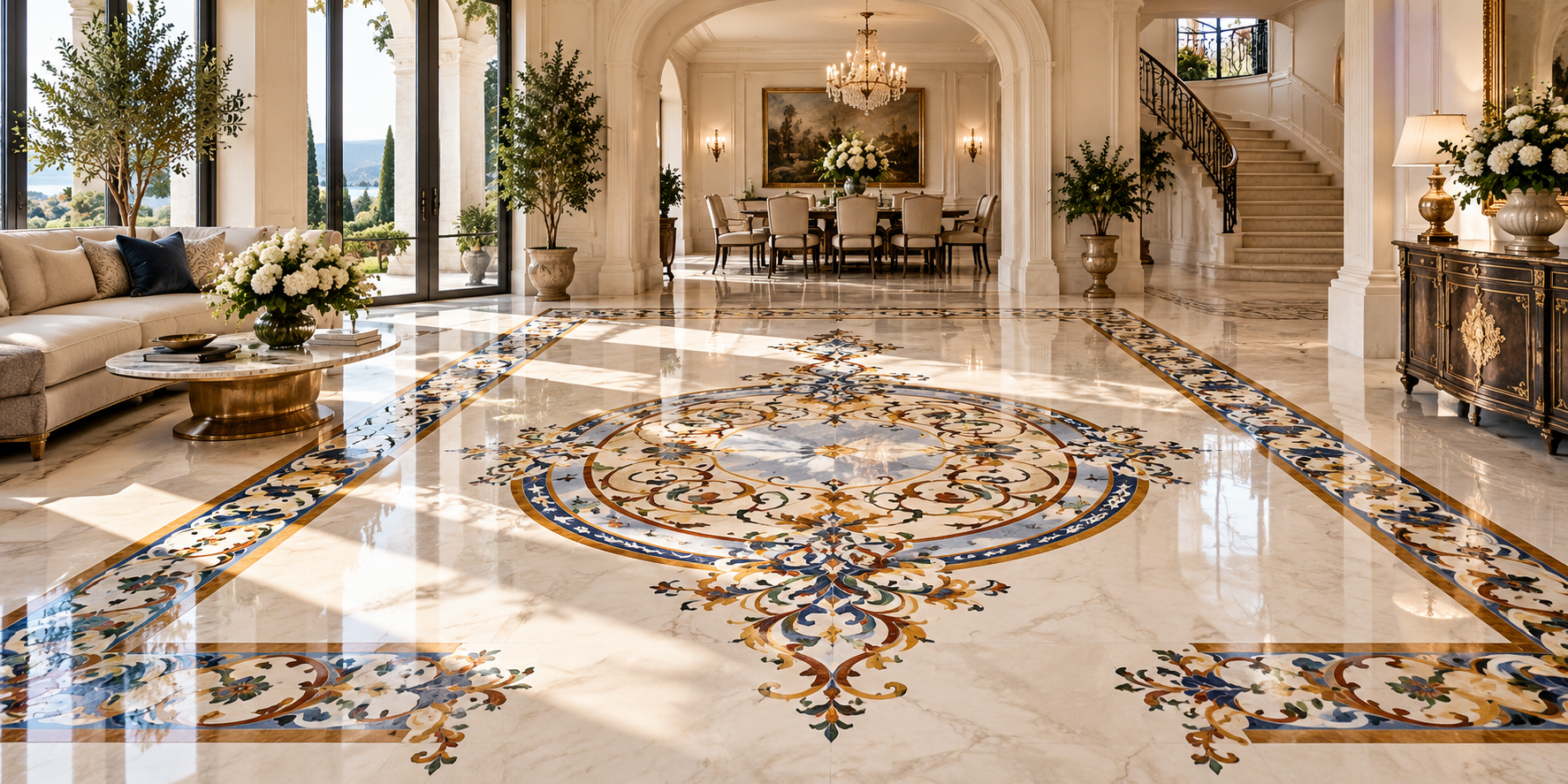
Pietra Dura (Italian for “hard stone”) is a decorative hardstone-inlay technique in which carefully shaped pieces of coloured stone are fitted together to form a design. The stone pieces are selected for their natural colour, veining, translucency and texture, then cut and finished so that the composition reads as a unified surface.
The technique is associated particularly with the Italian Renaissance and the celebrated workshops of Florence, where artisans developed highly refined compositions using hardstones such as lapis lazuli, jasper and other richly coloured materials. The Metropolitan Museum of Art documents the development of the European pietre dure tradition, its Medici patronage in Florence and the use of natural stone characteristics to create detailed floral, landscape and geometric imagery.
In contemporary interiors, the term is commonly used for bespoke natural-stone inlay in architectural surfaces and decorative objects. The exact design, materials, construction and installation method should always be considered in relation to the intended application.
Pietra Dura and marble inlay are closely related terms, but they are not always used in exactly the same way. Marble inlay is a broad description of decorative stone pieces set into a marble or other stone surface. Pietra Dura traditionally refers to a more specific hardstone-inlay approach in which individually shaped coloured stones form a composed image, motif or pattern.
In commercial and architectural language, the terms can overlap. A project may combine a marble ground, contrasting stone borders, geometric sections and detailed hardstone motifs. The correct description depends on the materials, technique and design actually being specified—not simply on the name used to market it.
Monarch Crafts works with the wider language of natural-stone inlay, including bespoke Pietra Dura compositions and marble inlay applications. For a broader overview of the atelier’s work, explore marble inlay flooring, marble inlay table tops and marble inlay wall panels.
Florence became one of the most influential centres for pietre dure during the Renaissance. The Medici court established the Galleria dei Lavori in 1588, the workshop that became the Opificio delle Pietre Dure. Florentine artisans became renowned for assembling carefully selected hardstones into refined images, including flowers, foliage, landscapes and decorative objects. The natural variations within each stone were treated as part of the artistic vocabulary.
The technique was used for furniture, table tops, cabinets, caskets, vessels and other objects made for European courts and collectors. The Opificio’s museum explains the historical workshop, its materials and the processes behind Florentine commesso work.
India has its own distinguished history of decorative stone inlay, especially the Mughal-era tradition often referred to as Parchin Kari. It is widely associated with architectural ornament in marble, including floral and vegetal compositions made from carefully cut and fitted stones. The Taj Mahal is among the best-known historical expressions of this tradition.
Florentine commesso and Indian Parchin Kari share the principle of fitting shaped stone pieces into a larger composition, but their histories, workshop practices, design vocabularies and regional contexts are distinct. They should not be treated as interchangeable names for one identical technique.
Monarch Crafts is based in Jaipur, Rajasthan, where its work draws on the region’s living stone-working environment while responding to contemporary architectural briefs and international design references.

Material selection is central to the character of a Pietra Dura composition. A stone is not chosen only for its colour name: its natural pattern, consistency, workability, thickness, surface finish and suitability for the application all matter. The final palette is developed around the design and the stones that can be responsibly sourced and worked for the project.
Not every stone is appropriate for every project. The material schedule should be confirmed after reviewing the design, the intended environment, the required finish and the practical demands of fabrication and installation. Where a project specifies a particular gemstone or stone variety, availability and suitability should be verified before final approval.
Traditional hardstone inlay is a patient, detail-led process. The sequence varies with the design and the object being made, but a commission generally moves through a series of coordinated stages.
The Metropolitan Museum’s account of historic Florentine production describes full-scale designs, the selection of stones for their natural colour ranges, specialist cutting and the skilled adjustment of details to the character of the material. These principles help explain why natural-stone inlay is both a design discipline and a specialised craft.

The design vocabulary of Pietra Dura is broad. It can be highly naturalistic, architectural, symbolic or abstract. A successful composition is developed for its setting rather than selected only as an isolated pattern.
Flowers, leaves, stems and flowing branches are among the recognisable subjects in historical and contemporary stone inlay. Natural stone colours can be used to create contrast between petals, foliage and the ground while allowing each material’s own pattern to contribute to the image.
Geometric arrangements, interlocking forms, repeating borders and symmetrical compositions are suitable for architectural settings where rhythm, proportion and alignment with the room are important.
Floor medallions can define an entrance, central hall or formal interior. Their diameter, border, orientation and relationship to surrounding floor modules should be coordinated with the architectural plan.
Where a brief calls for a specific emblem, calligraphic element, symbolic motif or figurative subject, feasibility depends on the level of detail, scale, stone palette and fabrication requirements. Design approval should take place before production begins.
Natural-stone inlay can be developed for a single statement piece or coordinated across a larger architectural scheme. The application determines the design scale, construction details, finish and installation planning.
Floor medallions, decorative borders, floral panels and coordinated floor compositions for entrance halls, villas, palaces and other considered interiors.
Explore flooringDining, centre, coffee, side and console table tops developed around the dimensions, furniture structure and visual character of the commission.
Explore table topsDecorative inlay panels, framed works and architectural feature panels for private interiors and selected public settings.
Explore wall panelsInlay integrated with floors, staircases, borders and other architectural features, coordinated with the wider project design.
Explore architectural inlayDecorative stone artworks and individually developed commissions intended for display, private collections and distinctive interiors.
Explore art and collectors’ piecesProject-specific work developed from an architect’s drawing, a client’s reference, a design concept or a particular architectural requirement.
Discuss a bespoke commissionMonarch Crafts is a Jaipur-based Pietra Dura atelier and manufacturer of bespoke natural-stone inlay. We welcome enquiries from private clients, architects, interior designers, developers, hospitality teams and project consultants seeking individually developed stone-inlay work.
After reviewing the brief, the next discussion can establish the design direction, material options, dimensions, scope, production considerations and responsibilities for delivery or installation. Technical feasibility, final specifications, lead times, packaging, shipping and site coordination are confirmed individually for each project. No standard price or production period should be assumed before the scope is understood.
For professional teams, the Architects & Designers page provides a dedicated starting point. You can also review natural stone and material considerations or send a project brief through the enquiry page.
Monarch Crafts’ work includes bespoke natural-stone inlay for architectural and decorative settings. One documented example is the marble inlay contribution for the ISKCON Temple at Piramal Vaikunth, Thane. The temple was inaugurated on 17 March 2024. The inlay work is one part of a larger architectural and devotional project.
Monarch Crafts has also received a Silver-Gilt Award at the Chelsea Flower Show for its Million Dreams work. The atelier’s experience includes restoration work associated with Her Highness Hajah Mariam of Brunei. Project references and the scope of each commission should be considered individually; these examples are not presented as claims that Monarch Crafts designed or constructed the wider buildings.
For further context, visit selected projects and About Monarch Crafts.
For clients researching a Pietra Dura manufacturer in India, Monarch Crafts offers a Jaipur-based point of contact for bespoke natural-stone inlay commissions. A project can begin remotely with drawings, dimensions, photographs, material preferences and a discussion with the client or design team. The practical arrangements for samples, approvals, production, packing, shipping and site installation are established according to the project’s location and scope.
We are interested in enquiries from the United States, the United Kingdom, Europe, the Gulf region and other international markets where clients are seeking specialist natural-stone inlay for private residences, estates, hotels, institutional interiors and architectural projects. Country-specific customs, import duties, shipping requirements, local codes and installation arrangements must be checked for each destination.
For a useful first discussion, share the project location and whether the requirement is for a finished object, a fabricated architectural component or a larger coordinated installation.
Natural-stone inlay requires decisions that connect design, material behaviour and workmanship. A specialist atelier can help translate a visual reference into a composition that can be made from real stone, with attention to scale, colour relationships, component shapes, joints and finishing.
At Monarch Crafts, each enquiry is considered in relation to its intended use and architectural context. The objective is not to offer a one-size-fits-all pattern, but to develop a suitable approach for the commission. This is especially important for large floor medallions, coordinated panels, bespoke furniture tops and architectural features where dimensions and site conditions influence the final result.
Pietra Dura is Italian for “hard stone”. In decorative arts, the term commonly refers to hardstone inlay in which shaped pieces of coloured stone are fitted together to create a pattern, image or composition.
The terms overlap, but they are not always identical. Marble inlay is a broad description of decorative stone set into a marble or stone surface. Pietra Dura traditionally refers to a hardstone-inlay technique using shaped pieces of coloured stone to form a composed design.
Depending on the design and application, materials may include marble, lapis lazuli, jasper, agate, malachite, carnelian, onyx and other suitable decorative stones. The final selection depends on availability, workability, colour, natural pattern and intended use.
Florentine commesso di pietre dure developed in the Italian court-workshop tradition, particularly in Renaissance Florence. Parchin Kari refers to an Indian tradition of decorative stone inlay associated with Mughal architecture. Both use fitted stone components, but their histories and design traditions are distinct.
Yes. Stone inlay can be incorporated into floor medallions, borders and larger floor compositions. The design and construction must be planned for the dimensions, substrate, traffic, finish and installation conditions of the space.
Monarch Crafts welcomes bespoke enquiries for flooring, table tops, wall panels, architectural inlay and collector pieces. Share your drawings, dimensions, reference images and project location so the atelier can review the brief.
Yes. Monarch Crafts is based in Jaipur and welcomes international enquiries. Production, packing, shipping, approvals and any installation coordination are discussed and confirmed according to the project scope and destination.
There is no single standard price for bespoke Pietra Dura. Cost depends on dimensions, design complexity, stone selection, thickness, backing or substrate, finishing, quantity, fabrication requirements, packing, shipping and installation scope. A project-specific quotation can be considered after reviewing the brief.
Lead time depends on the scale and complexity of the design, material selection, approvals, production requirements and shipping arrangements. A realistic programme can be discussed once the scope and destination are known.
For readers interested in the historical and technical background of hardstone inlay, these museum resources provide useful context:
Whether you are planning a floor medallion, a bespoke table top, a decorative wall panel or an architectural inlay project, share your brief with Monarch Crafts. Include drawings or reference images, approximate dimensions and the project location to begin a focused discussion.